We've spent years building revenue operations infrastructure inside PE portfolio companies. We're no strangers to getting our hands dirty directly within various companies' GTM systems - configuring the CRM, building core operating dashboards, setting up the processes that sales teams use every day.
Unsurprisingly, patterns have emerged doing this work. And here's what we keep seeing: most PE firms land on one of two extremes when it comes to RevOps. Both feel logical, but both can backfire.
The Two Mistakes
Mistake #1: Pushing ops before the team is ready.
One PE operating partner we work closely with told us they tried hiring a full-time ops person to sit centrally across their portfolio. The initiative failed. The ops person kept pushing projects ahead of where the companies actually were maturity-wise. They were building things nobody asked for or understood the value of. Resulting adoption was low because the teams weren't ready or invested in what was being pushed on them.
As our partner put it: "Investors want to make sure there's 'flossing' going on, but maybe they shouldn't be the ones buying the electric toothbrush".
They eventually scrapped the hire and moved to a lighter retainer model where portfolio companies could opt into services when they were ready. Pull, not push.
Mistake #2: Staying too hands-off and hoping for the best.
The other end of the spectrum is the firm that says "We'll just let the companies figure it out - they know their own business best." The PE partners see their role as investors who advise on strategy, but who ultimately leave the operational foundation to their portco's team.
The problem is that it's very common for the type of firms that private equity invests in to have great product-market fit but zero operational rigor. They live out of spreadsheets, or a CRM that's been duct-taped or vibe-coded together. Sales reps have no guardrails, data quality is poor, and operations aren't set up to scale. As a result, there's no standardized way to answer fundamental basics like how many leads came in last week or what's our forecast accuracy.
By the time the team "figures it out," or brings in a consulting partner to help solve things, there's a trail of missed opportunities and a mountain of tech debt and dirty data that takes months to unwind.
What Actually Works
The firms getting this right approach RevOps in a more nuanced fashion: they preemptively put a foundation in place for when the team is ready to buy in.
On day one - or as close to it as possible - you put in place a clean, opinionated framework that captures the data you fundamentally need to run the business without adding unnecessary overhead.
What does that look like? A simple but clean lead-to-cash process, with guardrails preventing reps for creating garbage data or leaving key information like contracts outside of the CRM. Standardized reporting so an operating partner can log into any portfolio company and see the same metrics, the same dashboards, the same fields.
We've done this across multiple portfolio companies. The result is that the PE partners can now log into any of their portcos' HubSpot or Salesforce and immediately know where to look and how the company is performing.
Anything additional to that, such as attribution models, product feedback loops, territory mapping, CPQ tooling etc, gets layered in only when the team asks for it or there's a strong business need. In a nutshell: when the team's ready. That way the team is asking for additional capabilities instead of having them foisted onto them.
The Six Core Questions
Every company in a portfolio should be able to answer six basic questions accurately on demand.
- How many leads were created last week, and where did they come from?
- How many target opportunities were created, and where did they come from?
- How many customers do we expect to add next month, and at what revenue?
- How many new customers did we add last week; where did they come from, and why did they buy?
- How many deals did we lose last week?
- How many customers churned last week and why?
If a company can answer those six questions with confidence, it means the underlying infrastructure is probably in decent shape. If they can't, that's a signal. Not to push a massive ops overhaul, but to get the basics in place so the team can start pulling.
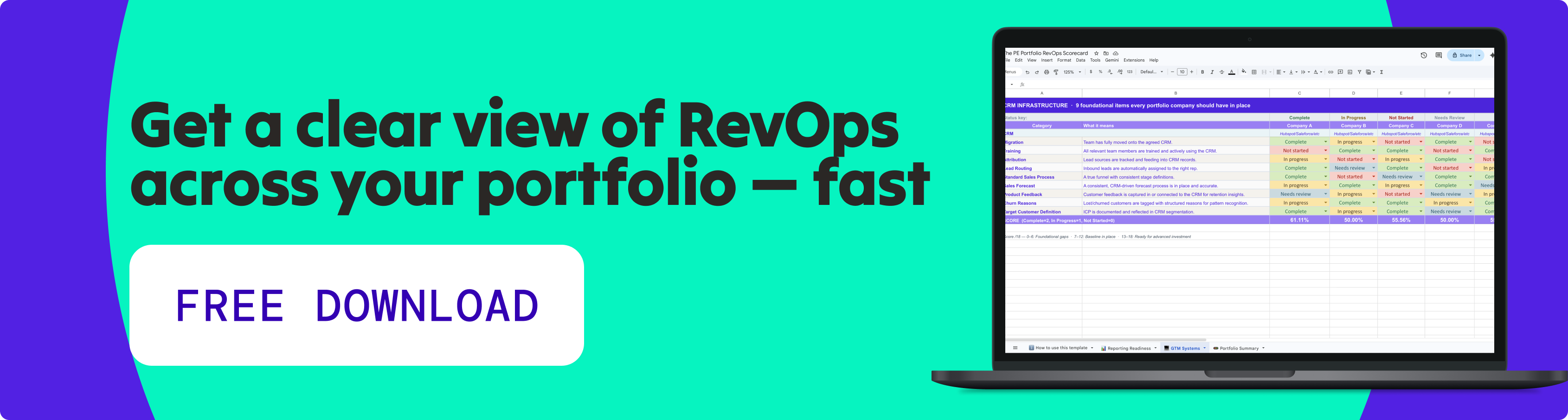
This is where a RevOps readiness scorecard becomes really useful. It gives you a structured way to assess where each portfolio company stands across reporting, GTM infrastructure, and CRM maturity.
Luckily - we've already built one, which you can grab right here 👇
Meet Them Where They Are, Set Them Up for Scale
The portfolio companies we onboard onto this kind of framework can come from any background and any maturity level. Some are on HubSpot. Others have their own homegrown CRM. Some are on Salesforce but it's a disaster. Some use spreadsheets.
It doesn't matter where they start. What matters is where you land them.When we deploy our startup framework, it's not a vanilla CRM setup. It's a curated system architecture: streamlined opportunity creation, a quoting process with built-in approvals, fields and dashboards that are consistent across every company in the portfolio. Reps can't go off-script, but they're also not too restricted. Data is clean from day one, not something you have to go back and fix six months later while pulling all-nighters.
And it's modular. A company that's just getting started gets the full foundation. A more mature company that already has Salesforce but needs better quoting and pipeline structure? We can slot in just the pieces they need without disrupting what's already working.
This also unlocks a startup-friendly operating model whereby the portco is able to hire a strong RevOps person and then enable them to capitalize on a higher ROI by partnering with an external partner like ourselves. The internal hire owns priorities and context. We are their sounding board, sharing best practices in terms of technology and architecture that we've seen and defined across similar companies, as well as their technical execution partner.
This setup is lighter on the balance sheet because we're a non-recurring charge and it scales up or down based on what the company actually needs.
The Bottom Line
RevOps in a PE context is about guidance and readiness, not restrictive control. The firms that get this right don't micromanage their portcos' CRM - but they also don't leave it to chance. They set a standard, install a foundation, and create the conditions for teams to pull when they're ready.
If you're an operating partner trying to figure out where your portfolio companies stand today, or a RevOps leader inside a portco wondering whether you have the basics covered, start with an honest assessment.
We built a free RevOps Readiness Scorecard that covers reporting maturity, GTM infrastructure, and CRM health across the metrics that actually matter to PE-backed companies. It's the same framework we use when onboarding new portfolio companies.


.png)